
📌 Key Ideas
- 📈 Directional Understanding: Profit depends on correctly predicting market movement
- ⏳ Time Decay: Option value reduces as expiry approaches, even without price change
- 🌪️ Volatility Impact: Higher volatility increases premium, lower volatility reduces it
- 💰 Limited Risk for Buyers: Maximum loss is restricted to the premium paid
- ⚖️ Risk Management: Position sizing and stop-loss are essential for consistency
- 🎯 Strategy Selection: Choose call or put based on clear market view
- 🧠 Discipline: Avoid emotional decisions and follow a structured trading plan
Options trading is a structured approach to participating in the stock market without directly owning the underlying asset. It is widely used by traders and investors for speculation, hedging, and managing risk across different market conditions.
For beginners, options trading may initially appear complex due to elements such as strike price, premium, expiry, and volatility. However, when understood step by step with a disciplined approach, it becomes a logical and manageable process. If you are new, you can first read Understanding of Future and Option Trading to build a strong foundation.
Key Aspects of Options Trading
- Learning and Discipline Requirement:- Although options trading involves multiple variables, consistent learning and disciplined execution help in building long-term proficiency.
- Derivative-Based Structure:- Options derive their value from underlying assets such as stocks or indices, allowing participation without direct ownership.
- Risk Management Capability:- Options are widely used to hedge existing positions and manage downside risk in volatile market conditions.
- Strategic Flexibility:- Traders can design strategies to benefit from rising, falling, or sideways markets, depending on their outlook.
- Defined Risk for Buyers:- In option buying, the maximum loss is limited to the premium paid, making it a controlled-risk approach.
Table of Contents
Understanding Options Trading
Options trading involves buying and selling contracts that provide the right, but not the obligation, to buy or sell an asset at a predetermined price within a specific period. These contracts derive their value from underlying assets such as stocks or indices.
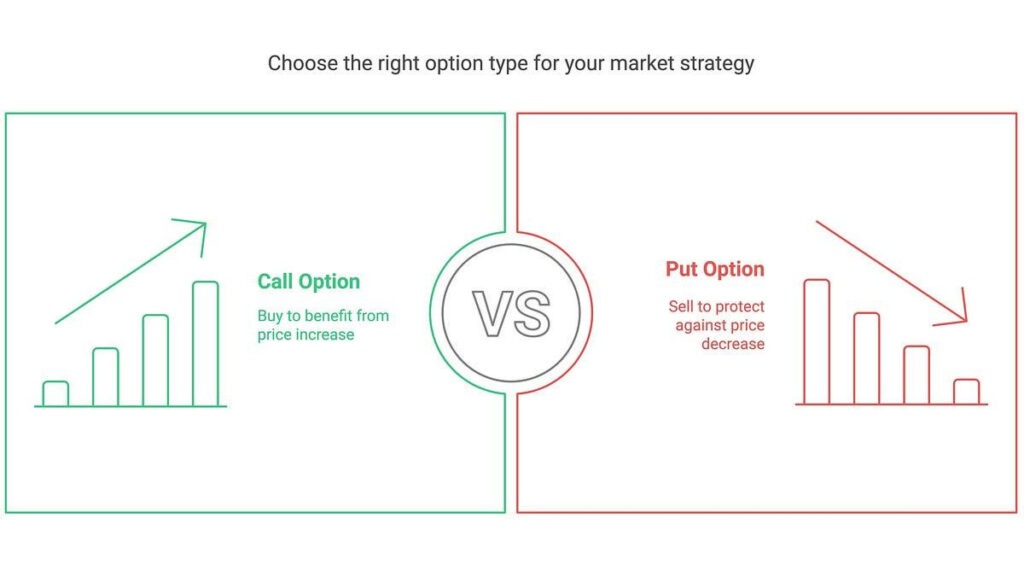
- Call Option: Used when expecting price increase.
- Put Option: Used when expecting price decrease.
- Premium: Cost of the option contract.
How Options Trading Works
Options trading is fundamentally based on predicting the future price movement of an underlying asset and managing risk through premium-based contracts. Unlike direct stock trading, where profit depends only on price movement, options trading is influenced by multiple factors such as direction, time, and volatility.
The value of an option, known as premium, changes dynamically based on these factors. Understanding how these elements interact is essential for making consistent and informed trading decisions.
1. Directional Movement
Directional movement refers to the expected price trend of the underlying asset. This is the most fundamental factor in options trading, as profits depend on whether the market moves in the anticipated direction.
- Correct Prediction: When the market moves in the expected direction, the option premium increases, resulting in profit. For example, a call option gains value when prices rise.
- Incorrect Prediction: If the market moves against the position, the premium decreases, leading to a loss. This makes directional accuracy crucial.
- Trend Strength: Strong market trends lead to faster premium movement, while sideways markets may result in limited gains.
2. Time Decay
Time decay, also known as Theta, refers to the gradual reduction in the value of an option as it approaches its expiry date. This is one of the most important concepts that traders must understand.
- Value Reduction Over Time: Even if the market price does not move, the option premium decreases due to loss of time value.
- Impact on Buyers: Option buyers are negatively affected by time decay, as their contracts lose value each day.
- Faster Decay Near Expiry: The effect of time decay increases significantly as expiry approaches, especially in the final days.
3. Volatility
Volatility represents how much and how quickly the price of an asset moves. It plays a major role in determining the premium of an option.
- High Volatility: When volatility increases, option premiums rise because larger price movements are expected.
- Low Volatility: When volatility decreases, option premiums fall, even if the price moves in the correct direction.
- Event Impact: Events like earnings announcements or major news can increase volatility and significantly affect option pricing.
4. Overall Understanding
Options trading is influenced by a combination of direction, time, and volatility. A successful trade requires alignment of all these factors, not just one. Even if the price moves in the expected direction, time decay or low volatility can reduce profits.
Therefore, traders should focus on analyzing all three elements together and follow a disciplined approach to improve consistency in options trading.
Explore Investment Guides & Stock Market Learning
Step-by-Step Process to Start Options Trading
Starting options trading requires a systematic approach. Each step helps improve decision-making and reduces risk.
Starting options trading requires a systematic approach. Each step plays a critical role in improving decision-making and reducing unnecessary risk. Following a structured process helps traders build consistency and avoid common beginner mistakes.
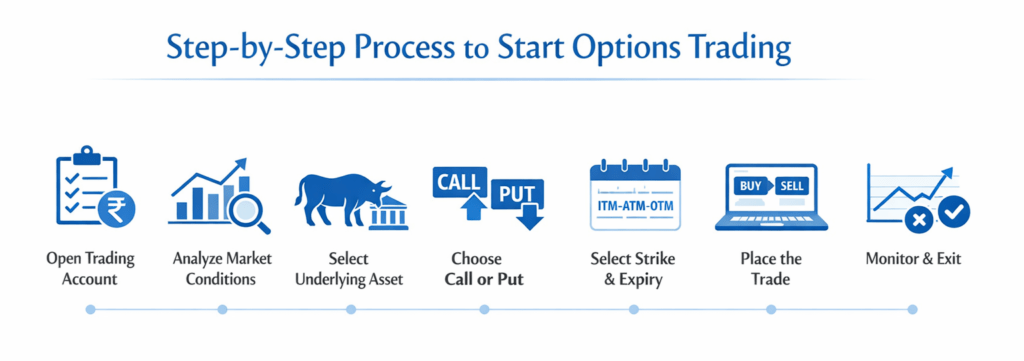
Step 1: Open a Trading Account
To begin options trading, you must first open a Demat and trading account with a broker that supports the derivatives segment. Without enabling the F&O segment, options trading cannot be executed. This is the foundation step, as all trades will be placed through this platform.
- Account Setup: Ensure your Demat and trading accounts are properly linked and activated.
- F&O Activation: Complete documentation to enable derivatives trading.
- Platform Understanding: Learn how to use charts, order placement, and options chain.
Step 2: Analyze Market Conditions
Before placing any trade, it is important to analyze the market environment. Options trading is not based on guesswork but on understanding trends, volatility, and sentiment. This step helps you decide whether to take a bullish, bearish, or neutral position.
- Trend Analysis: Identify whether the market is moving upward, downward, or sideways.
- Volatility Check: High volatility increases premium, while low volatility reduces it.
- Market Sentiment: Understand whether traders are bullish or bearish.
Step 3: Select the Underlying Asset
Choosing the right asset is important for smooth execution and better results. Beginners should focus on highly liquid instruments because they offer tighter spreads and easier entry and exit.
- Index Options: Nifty and Bank Nifty are commonly used due to high liquidity.
- Stock Options: Large-cap stocks with high volume are preferred.
- Liquidity Importance: High liquidity ensures better price execution.
Step 4: Choose Call or Put
This step depends on your expectation of market direction. It is the core decision in options trading and directly impacts your profit or loss outcome.
- Call Option: Choose when expecting the price to rise.
- Put Option: Choose when expecting the price to fall.
- Directional Clarity: A clear market view improves trade success.
Step 5: Select Strike Price and Expiry
Strike price and expiry determine the risk, cost, and probability of your trade. Selecting the right combination is essential for balancing risk and reward.
- ATM (At-the-Money): Balanced risk and reward.
- ITM (In-the-Money): Higher probability but higher cost.
- OTM (Out-of-the-Money): Lower cost but higher risk.
- Expiry Selection: Weekly for short-term, monthly for stability.
Step 6: Place the Trade
Once all decisions are made, you can place your trade through the trading platform. Execution should be done carefully to avoid errors.
- Order Type: Use market order for quick execution or limit order for better pricing.
- Quantity Selection: Choose lot size based on capital and risk.
- Execution Discipline: Avoid impulsive entries.
Step 7: Monitor and Exit
After entering the trade, monitoring becomes essential. Proper exit planning helps in protecting profits and limiting losses.
- Stop-Loss: Define risk before entering the trade.
- Profit Booking: Exit when target is reached.
- Continuous Monitoring: Track premium and market movement.
Start Your Investment Journey with the Right Guidance
Premium & Time Decay
The premium represents the price paid by the buyer to acquire an option contract. It reflects the value of the opportunity embedded in the contract and is influenced by multiple factors, including the price of the underlying asset, time remaining until expiry, and prevailing market volatility.
Understanding how premium behaves is essential, as it directly determines both the potential profit and the maximum risk for option buyers.
Key Components of Premium
- Intrinsic Value:– The actual value of the option based on the difference between the underlying price and the strike price.
- Time Value:– The additional value attributed to the time remaining until expiry, which represents the possibility of favorable price movement.
- Volatility Influence:– Higher volatility increases premium due to greater uncertainty, while lower volatility reduces it.
Time decay, also known as Theta, is a critical concept in options trading. It refers to the gradual reduction in the value of an option as it approaches its expiry date, regardless of price movement.
This makes timing a crucial factor, as the value of the option can decline even when the market remains stable.
Impact of Time Decay
- Gradual Value Erosion:– Option premium decreases steadily as expiry approaches, reducing potential profitability.
- Accelerated Decay Near Expiry:– The effect of time decay becomes more significant in the final days before expiry.
- Negative Impact on Buyers:– Option buyers are directly affected, as their positions lose value over time if the expected move does not occur.
- Strategic Importance:– Traders must consider timing carefully to avoid losses due to time decay, even with correct market direction.
Overall Understanding
Premium and time decay together define a major part of options trading behavior. While premium determines the cost and potential reward, time decay continuously reduces value, making both timing and strategy selection critical for success.
Risk Management
Risk management is the most important aspect of options trading. Without proper control, losses can accumulate quickly. A disciplined approach ensures long-term sustainability.
- Position Sizing: Allocate a limited portion of capital to each trade to reduce risk exposure.
- Stop-Loss: Always define a stop-loss to limit potential losses.
- Discipline: Follow a structured plan and avoid emotional decisions.
Conclusion
Options trading is a powerful tool that allows traders to participate in the market with flexibility and controlled risk. It provides opportunities across different market conditions, but success depends on discipline and proper understanding.
A structured approach, supported by risk management and continuous learning, is essential for long-term success. Traders should focus on building consistency rather than chasing quick profits.
FAQs
Q 1. What is options trading in simple terms?
Ans. Options trading is buying and selling contracts that give the right to buy or sell an asset at a fixed price before expiry.
Q 2. Is options trading good for beginners?
Ans. Yes, beginners can start with simple strategies like option buying, but proper understanding and discipline are important.
- Start with call and put buying
- Avoid complex strategies initially
Q 3. How much money is needed to start?
Ans. The capital required depends on premium and lot size, but options allow starting with relatively lower capital compared to futures.
Q 5. What are the main risks in options trading?
Ans. The main risks come from wrong direction, time decay, and volatility changes.
- Loss due to incorrect market prediction
- Premium decay over time
- Low volatility impact
Q 6. Can I lose more than my investment?
Ans. If you buy options, your loss is limited to the premium, but option selling can involve higher risk.