
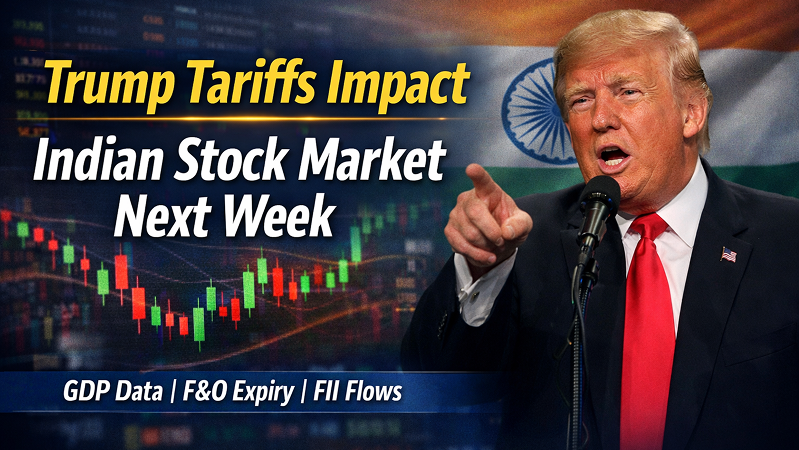
How Trump Tariffs May Impact Indian Stock Market Outlook Next Week

The Indian stock market outlook next week remains cautiously optimistic amid concerns over Trump tariffs, even as benchmark indices staged a strong rebound on Friday, February 20.
After witnessing sharp losses of over 1% in the previous session, the market bounced back with healthy gains supported by value buying in quality stocks.
The 30-share BSE Sensex climbed 317 points (0.38%) to close at 82,814.71, while the Nifty 50 gained 117 points (0.46%) to settle at 25,571.25.
Broader indices delivered mixed performance:
- BSE 150 MidCap Index: +0.44%
- BSE 250 SmallCap Index: –0.19%
Market experts believe volatility may remain elevated, but domestic fundamentals continue to provide strong support to the Indian stock market outlook next week.
How to Invest In Share Market as Beginners
Indian Stock Market Outlook Next Week After Trump Tariffs?
According to market analysts, strong domestic macroeconomic fundamentals, improving earnings growth, and stable demand conditions are acting as cushions against global uncertainties.
However, global cues such as US trade policies, geopolitical tensions, and commodity price movements will continue to influence short-term trends in the Indian stock market outlook next week.
Top 5 Triggers for Indian Stock Market Outlook Next Week
1. Trump Tariffs and Global Trade Developments
One of the biggest factors shaping the Indian stock market outlook next week is the evolving trade stance of the Donald Trump administration.
Investors will assess:
- Developments related to US tariff policies
- Any legal interpretations affecting global trade
- Progress on the proposed India–US interim trade agreement
Any shift in trade dynamics could impact global risk sentiment and influence Indian equities.
2. India’s GDP Data Release
Domestic macro data remains crucial for the Indian stock market outlook next week.
The Ministry of Statistics and Programme Implementation is scheduled to release the next quarterly GDP estimates on February 27.
Investors will closely monitor:
- GDP growth numbers
- Infrastructure output data
- Fiscal indicators
- Foreign exchange reserves
Stronger-than-expected GDP data could further boost market sentiment and earnings expectations.
3. Monthly F&O Expiry
The monthly F&O expiry is another major event that could increase volatility in the Indian stock market outlook next week.
Derivative positioning and rollover activity typically lead to:
- Sharp intraday swings
- Higher trading volumes
- Increased speculative activity
Traders should expect short-term volatility around expiry sessions.
4. Gold, Silver and Crude Oil Prices
Commodity markets are also influencing the Indian stock market outlook next week.
Gold and silver prices remained resilient amid:
- Rising geopolitical tensions
- Safe-haven buying
- Strong US Dollar movement
Meanwhile, crude oil is trading near key resistance levels. Any sharp movement in energy prices could impact inflation expectations and sector-specific stocks in India.
Metals continue to trade in rising channels, while energy counters are approaching supply zones — suggesting potential volatility ahead.
5. FIIs and DIIs Activity
Foreign institutional flows will play a decisive role in the Indian stock market outlook next week.
According to data from the National Securities Depository Limited, foreign portfolio investors (FPIs) turned net buyers in February, investing over ₹16,900 crore through exchanges and primary markets combined.
Key trends observed:
- Aggressive selling in IT stocks
- Increased allocation to financial services
- Strong buying in capital goods sector
Improving corporate earnings (Q3 FY26 showing 14.7% growth) are expected to attract more FPI inflows. Early estimates suggest FY27 earnings growth could be around 15%, making Indian valuations more attractive.
Sustained FII buying could provide strong support to the Indian stock market outlook next week.
How the stock market works
Indian Stock Market Outlook Next Week: Final View
Overall, the Indian stock market outlook next week suggests range-bound movement with stock-specific action likely to dominate.
While global trade developments and geopolitical tensions may create volatility, strong domestic macro fundamentals and improving earnings momentum are expected to provide downside protection.
Investors should:
- Monitor GDP data closely
- Track F&O expiry volatility
- Watch FII/DII flow trends
- Keep an eye on global trade and commodity movements
Short-term volatility may persist, but the broader structure of the Indian market remains constructive.
FAQs
1. How can Trump tariffs affect the Indian stock market?
Trump tariffs can impact global trade flows, investor sentiment and foreign institutional investments, which may create volatility in Indian equities.
2. Why is India’s GDP data important for the stock market?
GDP growth reflects economic strength. Strong data can boost earnings expectations and improve market sentiment.
3. What happens during F&O expiry?
F&O expiry often leads to high volatility due to position rollovers and short-term speculative activity.
4. Why are FII and DII flows important?
Foreign and domestic institutional flows influence liquidity and short-term market direction.